
Knowing how to choose the right cable tray matters, since there are many types on the market, made from different materials and with different surface finishes. As you research, you will come across products such as powder-coated cable trays, hot-dip galvanized cable trays, and more. So which type is right for your project? Here is a practical guide to choosing the right cable tray for your needs.
Types of Cable Trays
Guide to Choosing Indoor Cable Trays
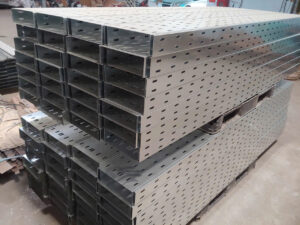
The cable tray types typically used for “ordinary indoor” projects are powder-coated cable trays or galvanized-sheet cable trays. “Indoor” here means locations that are sheltered from direct rain and sun. For indoor projects there are many suitable options. Both powder-coated and galvanized-sheet trays can also be used outdoors, provided the tray is finished with an outdoor-rated powder coating. “Outdoor” means locations exposed directly to rain and sunlight.
However, even in an indoor environment, if there are evaporating solvents, high humidity, or the location is near the coast with salt-laden air, it is better to use an aluminum alloy tray or a 304 stainless steel tray. A hot-dip galvanized cable tray can also be used in these conditions. Based on The Sun’s experience, an aluminum alloy tray is typically the optimal choice in these situations — it holds up well in this environment while costing less than 304 stainless steel, giving the best balance of economy and performance.
Guide to Choosing Outdoor Cable Trays
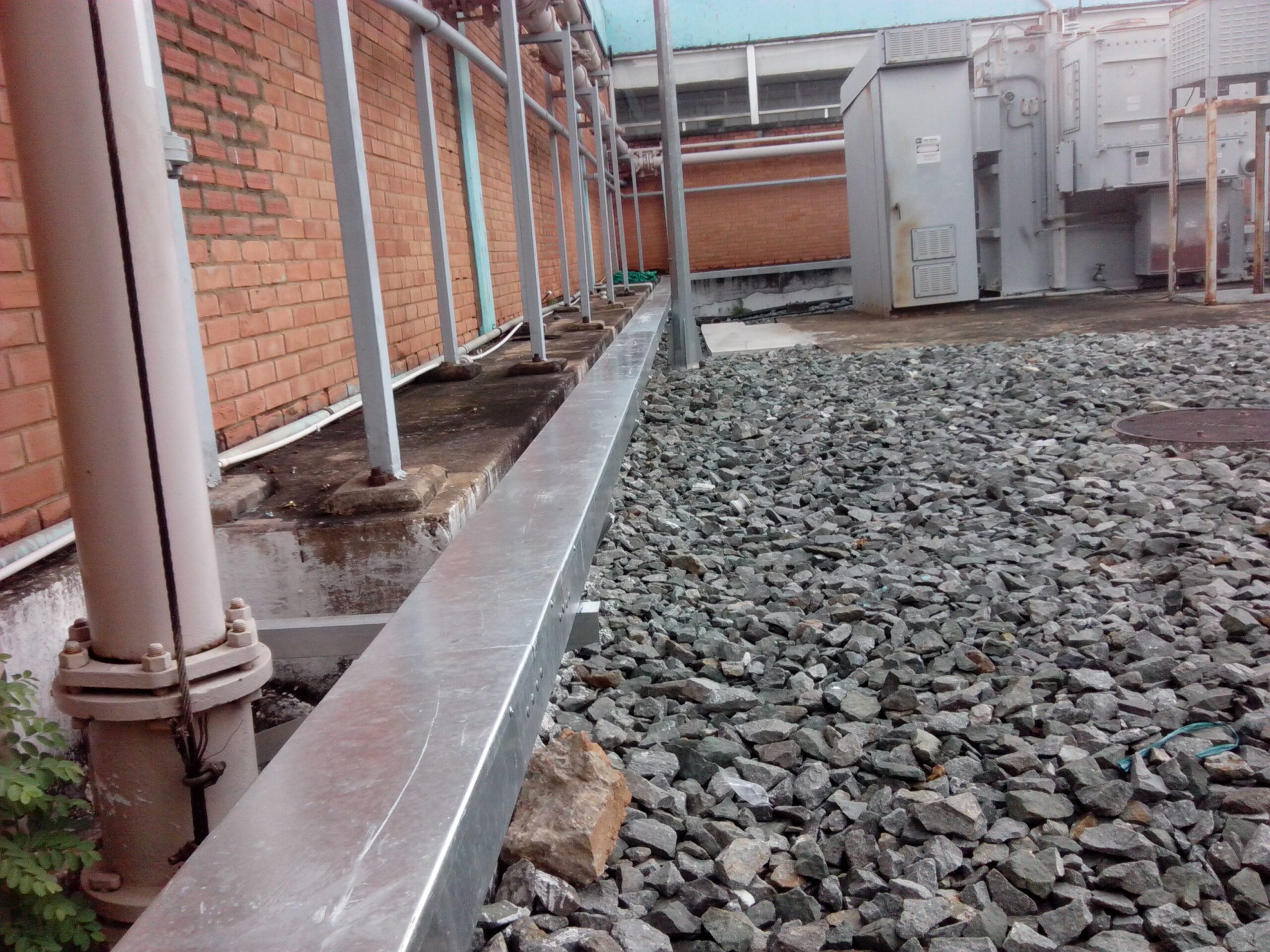
For outdoor projects, hot-dip galvanized cable trays and ladders are the most suitable choice. They achieve the best balance of cost, corrosion resistance, and structural rigidity. Hot-dip galvanizing is a process in which a steel cable tray is dipped into a bath of molten zinc, coating the tray in a layer of zinc that withstands weather exposure. Guardrails on bridges and street lighting poles are common real-world examples of hot-dip galvanized steel that holds up well outdoors over the long term.
Solar power projects typically use hot-dip galvanized trays and ladders to ensure long-term cable protection matching the service life of the solar panels. See our related article on choosing a cable ladder for solar power systems.
What Type of Tray Is Best for Rooftop Solar?
After extensive field testing, we typically recommend aluminum alloy cable trays for rooftop solar power projects. The reason for using perforated aluminum alloy trays is that aluminum is very lightweight — only about one-third the weight of hot-dip galvanized steel — which reduces the load on the roof structure. Being lightweight and easy to cut with hand tools also makes installation on a rooftop considerably easier compared with steel trays.
Choosing a Cable Tray by Price
In terms of price, the list below is ordered from lowest to highest cost:
- Galvanized-sheet cable tray: Most commonly used overseas.
- Powder-coated cable tray: The preferred choice in Vietnam.
- Hot-dip galvanized cable tray: Used for special requirements such as outdoor or damp environments.
- Aluminum alloy cable tray: Less commonly used in Vietnam, mainly due to unfamiliarity.
- 304 stainless steel cable tray: Excellent in every respect except price, so it is generally reserved for special requirements.
Choosing a Cable Tray Size Based on Your Cables
Definitions
All dimensions below are in millimeters (mm):
- OD: Cable outer diameter (including insulation and shielding)
- OD1…ODn: Outer diameter of cable type 1…n
- ODmax: Outer diameter of the largest cable type
- m1…mn: Quantity of cable type 1…n
- d: Spacing between cables
- S: Spare capacity percentage (for future cable additions)
- TOD: Total of all cable diameters
- TW: Total width of installed cables, including spacing between them
- TS: Total cross-sectional installation area, including spare capacity
- F: Fill-area percentage, typically 40%–60%
- SC: Required cross-sectional area of the cable tray/ladder
- R: Bend radius for elbows, tees, and crosses
Formulas
Total cable diameter: TOD = OD1×m1 + … + ODn×mn
Total installed width including spacing: TW = TOD + d×(m1+…+mn)
Total cross-sectional area including spare capacity: TS = (TW×ODmax)×(1+S/100)
Required tray/ladder cross-sectional area: SC = TS×(1+F/100)
Choose a tray with usable height (H) > ODmax, then calculate the required usable width: W > SC/H
Bend radius for elbows, tees, and crosses: R = 10×ODmax
Worked Example
Calculate the tray size needed to install the following cables, with spacing between cables d = 5mm, spare capacity 20%, and fill ratio F = 50%:
- Cadivi CVV 240mm² cable → OD = 26.6mm, quantity = 3
- Cadivi CVV 185mm² cable → OD = 23.8mm, quantity = 1
- Cadivi CVV 95mm² cable → OD = 17.9mm, quantity = 3
- Cadivi CVV 50mm² cable → OD = 13.9mm, quantity = 4
- Cadivi CVV 16mm² cable → OD = 9.6mm, quantity = 2
TOD = 26.6×3 + 23.8×1 + 17.9×3 + 13.9×4 + 9.6×2 = 232.1
TW = 232.1 + 5×(3+1+3+4+2) = 297.1
TS = 297.1×26.6×(1+20/100) = 9,483
SC = 9,483×(1+50/100) = 14,225
For a tray with H = 50mm → W = 14,225/50 = 284.5 → choose a tray with H = 50mm, W = 300mm.
For a tray with H = 100mm → W = 14,225/100 = 142.25 → choose a tray with H = 100mm, W = 150mm.
R = 10×26.6 = 266 → choose a bend radius of R = 300mm for elbows, tees, and crosses.