
- 🔬 What Is ZAM Steel? Decoding the “Super Alloy” of the Electromechanical Industry
- 🏭 Origin and Invention History of ZAM Steel
- ⚡ Why Has ZAM Steel Become the Leading Material for Cable Tray Manufacturing?
- 📐 Standard Technical Specifications of ZAM Steel Cable Trays
- 🏗️ Practical Applications: Which Projects Suit ZAM Steel Cable Trays?
- ⚖️ Comparing ZAM Steel With Common Cable Tray Materials
- 🔍 What to Check When Choosing a ZAM Steel Cable Tray Manufacturer
- ✅ Conclusion
🔬 What Is ZAM Steel? Decoding the “Super Alloy” of the Electromechanical Industry
If you are designing a wiring system for a factory, a commercial building, or a coastal industrial zone, there is a good chance your contractor will mention a “ZAM steel cable tray”. So what exactly is this material that technical experts rate so highly?
ZAM is short for the three elements that make up the alloy coating:
- Z – Zinc (Zn): The largest share (~91%), acting as a sacrificial protective layer that corrodes first to protect the base steel.
- A – Aluminum (Al): About 6–7%, forming a stable aluminum-oxide layer that blocks oxidation.
- M – Magnesium (Mg): About 3%, which maintains and regenerates the protective film even where the surface is scratched.
The combination of these three elements creates a property that no ordinary coated material has: the ability to self-heal at scratches — the ZAM surface reacts with the environment to form a new protective film at points that are cut or scratched during fabrication and installation. This is why many engineers describe it as “a surface that heals itself like skin”.
🏭 Origin and Invention History of ZAM Steel
Who invented ZAM steel?
ZAM is a steel alloy coated with zinc, aluminum, and magnesium, developed by Nisshin Steel — a major Japanese steel group. Some sources also credit the brand to Nippon Steel, one of Japan’s leading steel corporations.
Note: Nisshin Steel and Nippon Steel are in fact directly related — Nisshin Steel was a subsidiary/affiliate of Nippon Steel, and by 2019 it had been fully merged into Nippon Steel Corporation. Both names are therefore accurate, simply reflecting different periods of the same corporate group.
Development timeline
| Period | Event |
|---|---|
| 1970s | ZAM steel was first developed in Japan. Nisshin Steel researched and perfected the Zn-Al-Mg alloy formula to overcome the corrosion-resistance weaknesses of traditional galvanized steel. |
| Following years | ZAM steel was widely adopted across Europe and North America, where demand for materials that withstand harsh environments is very high. |
| Early 2000s | ZAM steel entered the Vietnamese market and has become increasingly popular thanks to its clear advantages over traditional coated steels. |
| Today | ZAM steel is produced to the JIS G3323 standard (the Japanese standard for Zn-Al-Mg alloy-coated steel) and has become a leading material for cable tray manufacturing in Vietnam and worldwide. |
Why did Japanese engineers invent ZAM?
The story behind ZAM began with a practical engineering problem: in the 1970s, Japanese industry needed a steel material durable enough to withstand marine and chemical-industrial environments, while traditional galvanized steel (GI) showed too short a service life. Nisshin Steel’s engineers experimented with adding aluminum and magnesium to the zinc coating — and found that with just 6% Al and 3% Mg, corrosion resistance increased dramatically, while the surface gained a remarkable self-healing capability at scratches. It remains a breakthrough that no coated material at a comparable price point has surpassed to this day.
⚡ Why Has ZAM Steel Become the Leading Material for Cable Tray Manufacturing?
1. Outstanding Corrosion Resistance — 10 to 20 Times Better Than Galvanized Steel
This is the number-one reason. In cable tray manufacturing, corrosion resistance is not just a matter of appearance — it is an electrical safety factor. A rusted cable tray can damage cable insulation, causing short circuits or even fire.
ZAM steel offers 10 to 20 times higher corrosion resistance than traditional galvanized steel, thanks to its triple-protection alloy mechanism (sacrificial zinc + aluminum oxide + regenerating magnesium). This is especially important for:
- Coastal industrial zones with high salinity
- Chemical plants with mild acidic/alkaline environments
- Hospitals and schools that require long-term safety
- Outdoor installations exposed directly to tropical rain and sun
2. Self-Healing at Cut Edges — An Advantage Hot-Dip Galvanizing Doesn’t Offer
When hot-dip galvanized steel is cut, the cut edge exposes unprotected base steel — the starting point for rust. With ZAM steel, the magnesium in the alloy reacts with oxygen and moisture at the cut edge, forming a new protective oxide film over the exposed steel. As a result, manufacturers can skip post-processing steps such as deburring and supplementary re-coating after cutting, saving significant cost and production time.
3. Simpler Manufacturing Process — More Competitive Pricing
Thanks to its self-healing property, ZAM steel eliminates several steps in the cable tray production line: no need to pass through a hot-dip bath after forming, no complex deburring, and no supplementary painting. This allows the final product price to compete with ordinary black steel, even though the raw material itself costs more.
4. High Aesthetics — Uniform Surface
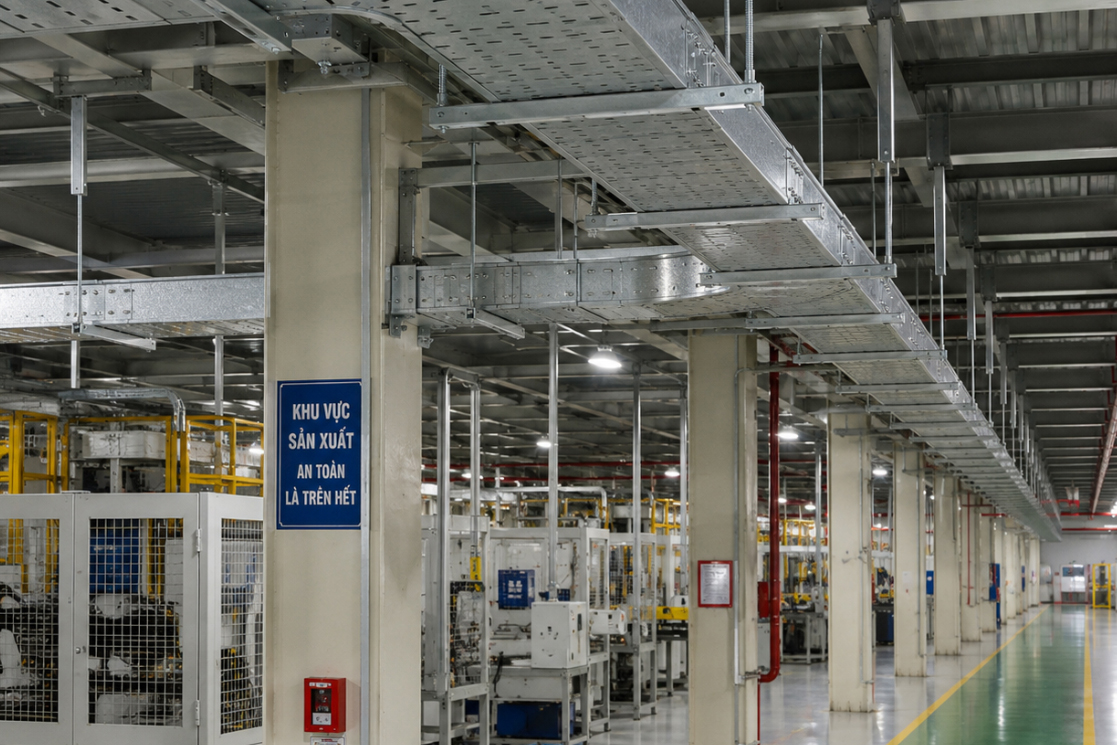
ZAM steel is coated through a computer-controlled thermal process, producing a uniform, glossy surface without the spangle pattern typical of hot-dip galvanizing. For office buildings, shopping centers, and hospitals — where cable trays may remain visible — this is a clear aesthetic advantage.
5. Environmentally Friendly
Manufacturing cable trays from ZAM steel causes less pollution than hot-dip galvanizing (no acid pickling baths or fluxing agents are required), and ZAM material is easy to recycle — matching the increasingly common requirement to green the supply chain.
📐 Standard Technical Specifications of ZAM Steel Cable Trays
| Specification | Common values |
|---|---|
| Cable tray width | 50 mm – 1000 mm |
| Cable tray height | 40 mm – 200 mm |
| Section length | 2.5 m or 3 m |
| Material thickness | 0.8 mm – 2.0 mm |
| Coating composition | ~91% Zn / 6–7% Al / 3% Mg |
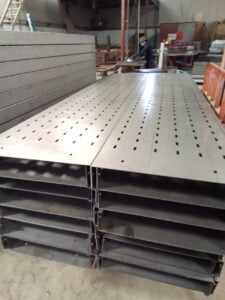
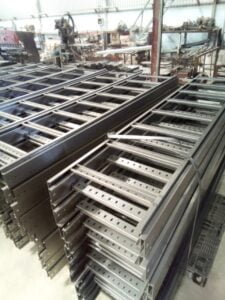
| Surface color | Light gray (natural) |
| Load capacity | Depends on thickness; meets most civil and industrial project loads |
Note for design engineers: ZAM steel has a harder coating than ordinary galvanized steel, so bending or stamping forces must be adjusted to avoid coating flaking at the bend. This should be taken into account when designing stamping dies and the cable-tray forming process.
🏗️ Practical Applications: Which Projects Suit ZAM Steel Cable Trays?
✅ Best suited for:
- Factories and production plants (humid environments, mild chemical exposure)
- Coastal industrial zones and the Mekong Delta region (saline environments)
- Hospitals and cleanrooms (hygiene requirements, no rust)
- Commercial buildings and offices (aesthetic requirements)
- Outdoor systems (roof canopies, basements prone to seepage)
- Projects requiring a 20–30 year material lifespan with no maintenance
⚠️ Consider alternative materials when:
- The project is small, budget is tight, and the indoor environment is dry — electro-galvanizing or powder coating may be more economical
- The environment involves concentrated acid/alkali — consider 304/316 stainless steel instead
- Cable loads are extremely heavy (>100 kg/m) — thickness must be carefully calculated
Besides ZAM steel cable trays, The Sun also manufactures cable trays in other materials, including powder-coated steel, hot-dip galvanized steel, coated sheet steel, 304 stainless steel, and aluminum alloy.
⚖️ Comparing ZAM Steel With Common Cable Tray Materials
| Criteria | ZAM Steel | Hot-Dip Galvanized | Powder-Coated | Stainless Steel |
|---|---|---|---|---|
| Corrosion resistance | ★★★★★ | ★★★ | ★★ | ★★★★★ |
| Self-healing at cuts | Yes | No | No | Yes (natural) |
| Aesthetics | ★★★★★ | ★★★ | ★★★★ | ★★★★★ |
| Price | Medium–high | Medium | Low–medium | Very high |
| Eco-friendliness | ★★★★ | ★★ | ★★★ | ★★★★ |
| Lifespan (harsh environment) | 20–30 years | 8–15 years | 5–10 years | 30+ years |
🔍 What to Check When Choosing a ZAM Steel Cable Tray Manufacturer
Many suppliers now offer ZAM steel cable trays, but quality varies widely. Here are the technical criteria worth checking:
- Ask for a certificate of origin for the ZAM steel — genuine ZAM steel should come with a certificate from the steel mill (commonly Nippon Steel, Japan).
- Check the coating thickness — measured with a coating-thickness gauge, not just taken on verbal assurance.
- Request technical drawings — a reputable manufacturer always provides clear 2D/3D drawings with fabrication tolerances.
- Check the bending/forming process — properly bent ZAM cable trays should show no coating flaking at 90° bends.
- Ask about the warranty policy — quality products typically come with a rust-free warranty of at least 5–10 years.
✅ Conclusion
ZAM steel is no longer an “unfamiliar” material — it has become the material of choice for cable tray manufacturing in projects that demand long-term durability in Vietnam. Its self-healing property at scratches, corrosion resistance 10–20 times better than galvanized steel, and simplified manufacturing process give ZAM steel real economic value over a project’s long life cycle — even when the initial cost is somewhat higher.
For MEP engineers and electrical contractors, understanding the nature of ZAM material helps you advise investors more accurately — choosing the right material for the right environment and the right budget. For general background, see the Wikipedia entry on galvanization, the corrosion-protection process ZAM steel improves upon.