
Knowing how to choose the right cable tray and ladder system is essential for project owners, MEP engineers and contractors before construction begins. Whether the project is a factory, office building or apartment complex, the cable-support system has a direct effect on electrical safety and cable service life.
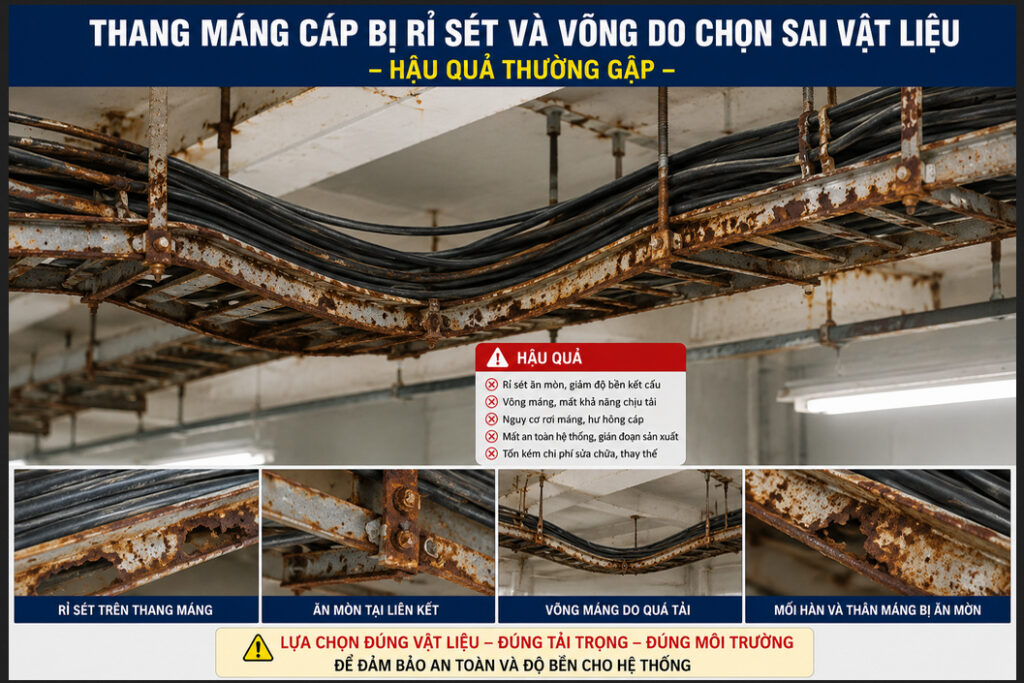
In practice, some projects must replace their complete cable tray system after only two or three years because of corrosion, excessive deflection or sharp edges that damage cable insulation and cause leakage currents. These failures often begin with an unsuitable product selection. Corrective work may cost three to five times more than choosing the correct system initially.
This guide from The Sun summarizes practical recommendations from electrical specialists so you can select the correct material, load rating, standard and system configuration while controlling project cost.
1. What Is a Cable Tray or Cable Ladder, and What Is Its Role?
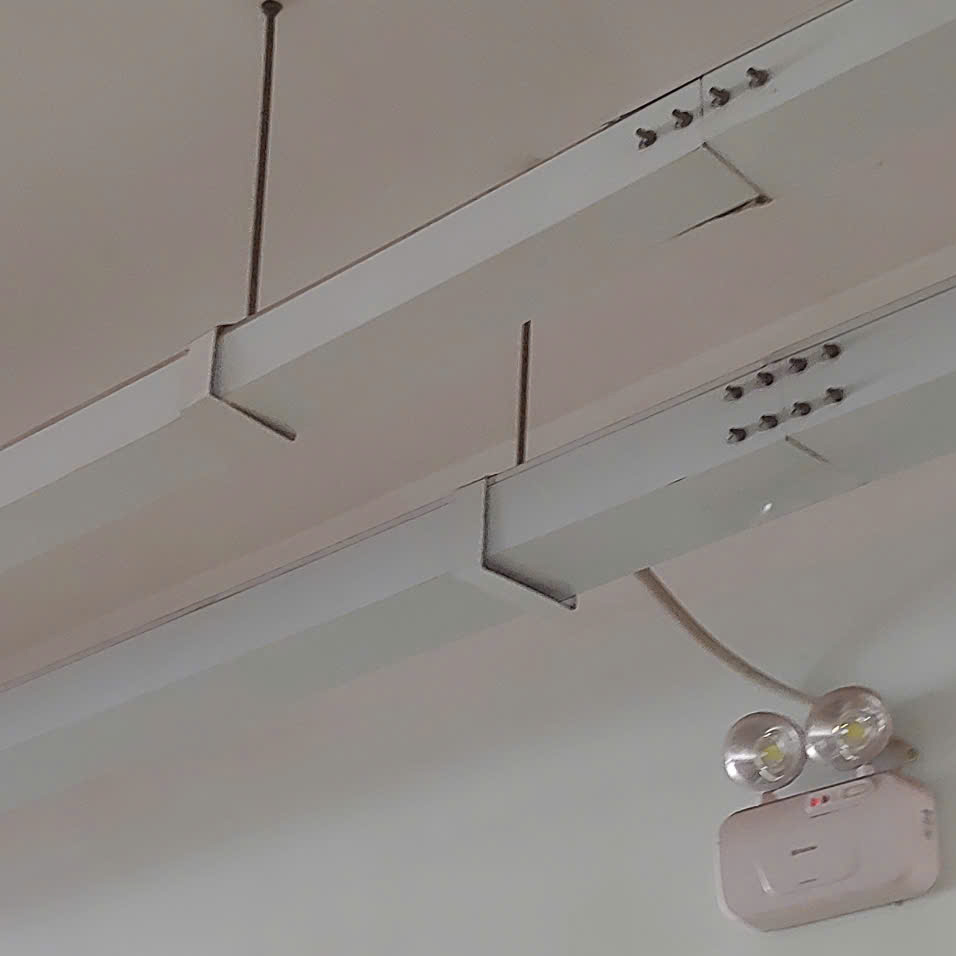
Cable trays and cable ladders are metal support structures used to support, route and protect power, control, signal and telecommunications cables in buildings and industrial facilities.
A properly selected cable-support system provides:
- Electrical safety: cables remain organized and are not crushed or exposed to sharp, hard surfaces.
- Easy maintenance: technicians can inspect and replace individual cable routes efficiently.
- A professional appearance: cable routes remain neat and orderly.
- Long service life: cables are not pulled or compressed and are better protected from environmental damage.
2. Common Types of Cable-Support Systems
One of the most important steps is understanding the available product types before ordering. Each type suits different loads and installation environments:
| Type | Characteristics | Suitable applications |
|---|---|---|
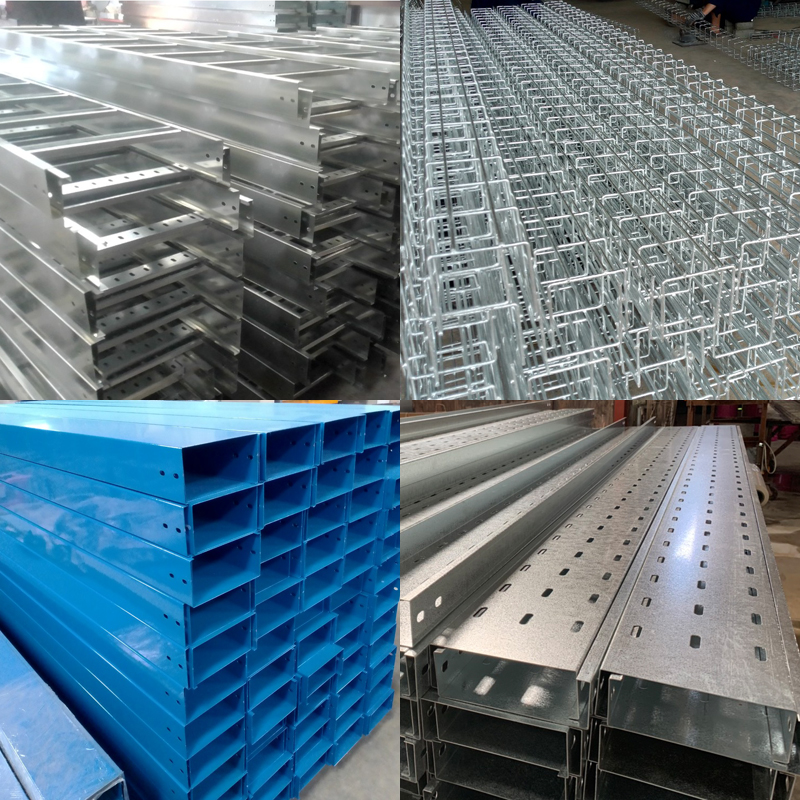
| Cable ladder | Ladder construction with very high load capacity | Heavy power cables, factories and industrial parks |
| Wire-mesh cable tray | Lightweight, well ventilated and quick to install | Signal cables, data centres and offices |
| Solid-bottom cable trunking | Comprehensive protection from dust and water | Wet or chemically exposed environments |
| Perforated cable tray | Good ventilation, economical and widely used | Commercial buildings and light industry |
3. How to Choose a Cable Tray Using Technical Criteria
The following selection guidance is organized by the technical criteria that should be confirmed before purchase. Applying these criteria helps the cable-support system remain safe and serviceable throughout the life of the facility.
3.1. Material and surface treatment
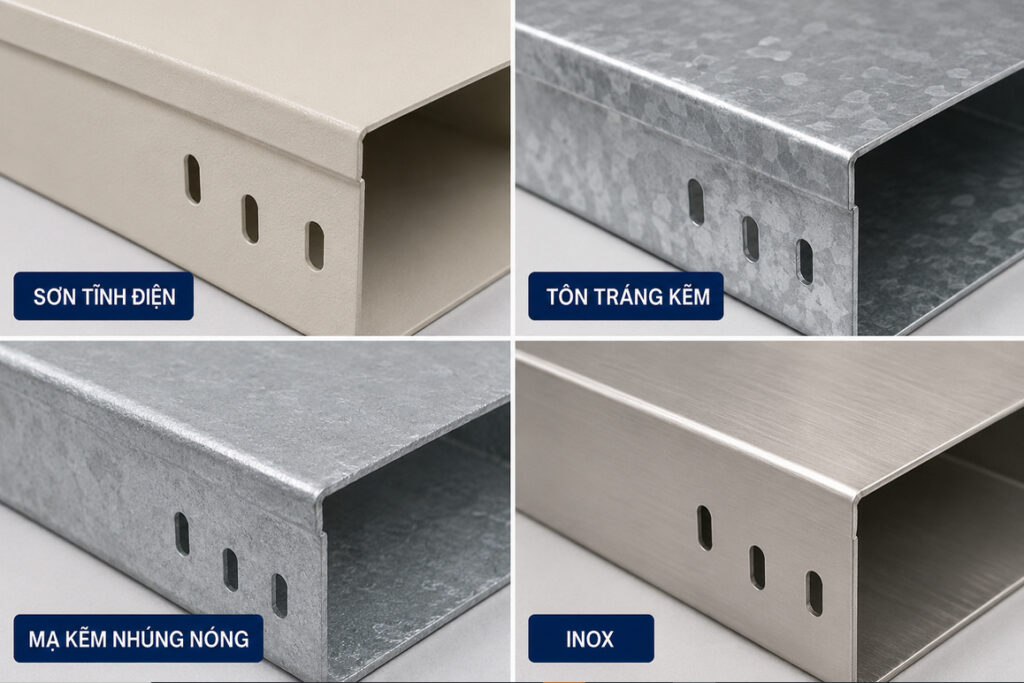
Material and surface treatment largely determine system service life, especially in high-humidity or weather-exposed locations.
- Hot-dip galvanized steel (HDG): a thick zinc coating provides excellent corrosion resistance. It is suitable for outdoor areas, factories and coastal projects.
- Powder-coated steel: offers an attractive finish and a wide range of colours. It is appropriate for indoor installations, offices and shopping centres.
- SUS 304 or SUS 316 stainless steel: provides maximum corrosion resistance for chemical, food-processing, seafood and coastal environments.
- Electro-galvanized steel: has a thinner zinc coating than HDG and should be limited to dry indoor environments.
⚠️ Warning: avoid trays finished only with conventional oil-based paint or products whose surface treatment is not documented. In Vietnam’s humid tropical climate, such products may begin corroding within 12–18 months.
3.2. Safe Working Load (SWL)
SWL is one of the most important technical ratings, but it is frequently overlooked. It is the maximum load that the manufacturer states the tray can safely support under the specified conditions.
How to calculate and select the required SWL:
- List every cable type to be installed and obtain its mass per metre (kg/m).
- Calculate the total cable mass for one metre of route.
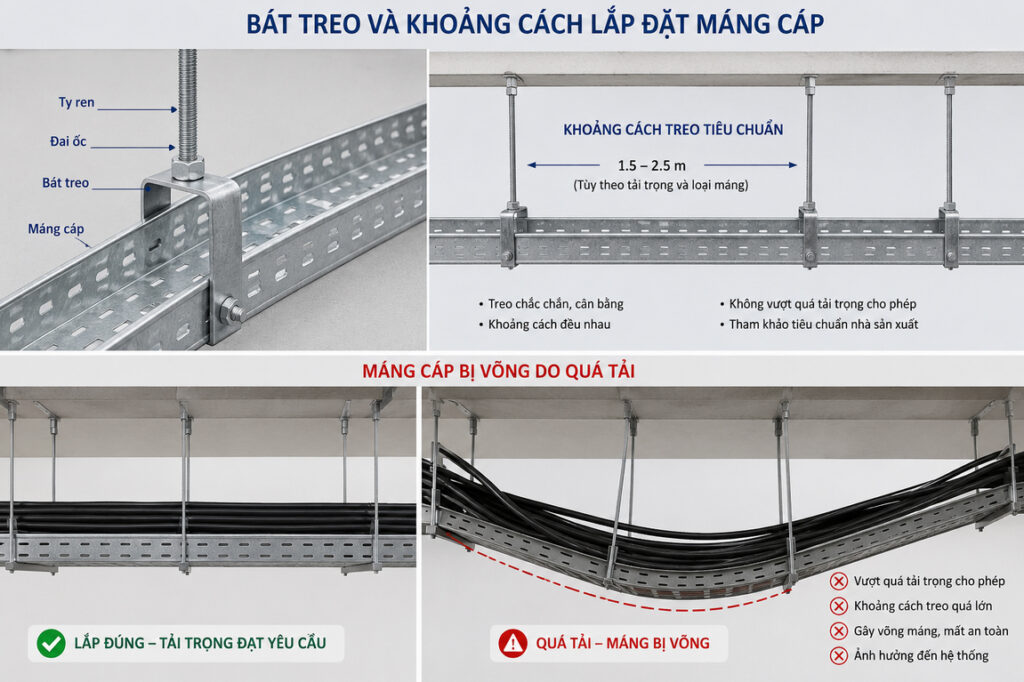
- Multiply this figure by the spacing between supports, commonly 1.5–2 m.
- Select a tray with an SWL at least 25–30% greater than the calculated operating load.
Example: the total cable load is 40 kg/m and support spacing is 1.5 m. The load per span is therefore 60 kg, so select a system with an SWL of at least 80 kg.
3.3. Cable-tray dimensions
Common width × height sizes include 100×50 mm, 200×100 mm, 300×100 mm and 400×100 mm. A standard straight length is 2.5 m.
Principles for selecting tray width:
- The combined cross-sectional area of all cables should not exceed 40% of the usable tray area.
- Allow spare space for heat dissipation and future cable additions.
Practical advice: selecting an undersized tray to reduce initial cost often results in tightly packed cables. Heat accumulation then accelerates insulation ageing. Experienced designers include spare capacity for future requirements.
3.4. Matching fittings and accessories
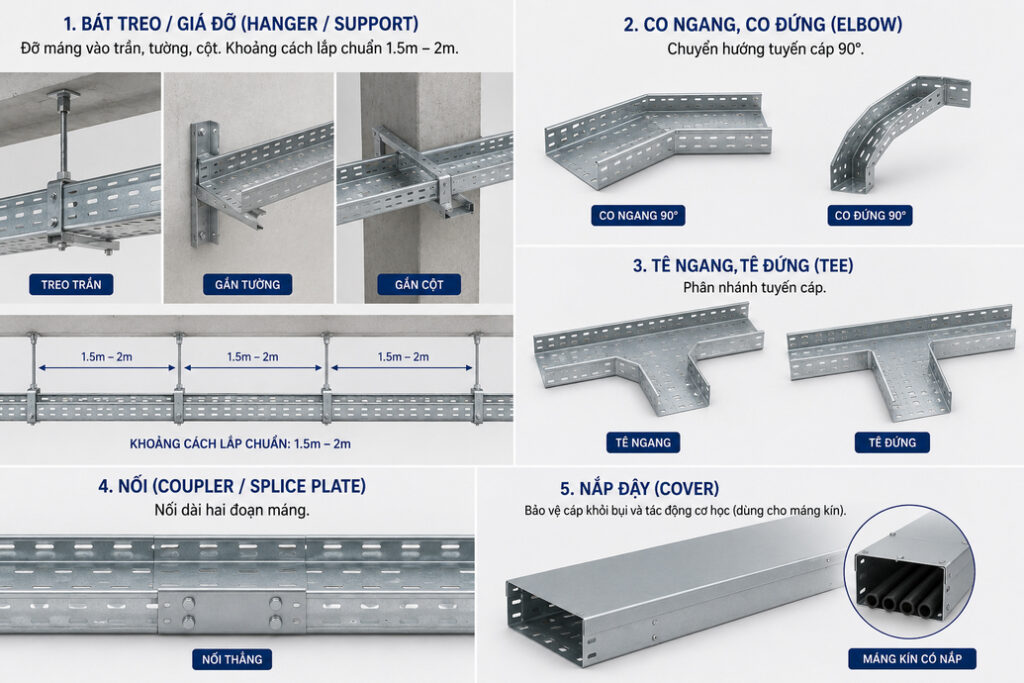
A complete cable-support system requires coordinated accessories:
- Hangers and supports: secure the tray to ceilings, walls or columns. Typical spacing is 1.5–2 m.
- Horizontal and vertical elbows: change the cable-route direction by 90°.
- Horizontal and vertical tees: create cable-route branches.
- Couplers or splice plates: join two straight sections.
- Covers: protect cables from dust and mechanical impact, particularly on solid-bottom trunking.
⚠️ Note: fittings should be supplied by the same manufacturer and in the same material as the straight sections to ensure correct fit, consistent appearance and uniform corrosion resistance.
3.5. Technical standards
Give preference to systems designed and tested to relevant international or national standards:
- IEC 61537: the widely used international standard for cable tray and cable ladder systems.
- NEMA VE 1: a US standard commonly specified for FDI projects and international factories.
- TCVN: Vietnamese standards applied to domestic and public-sector projects.
Request the supplier’s CO/CQ documentation (certificates of origin and quality). Avoid products that lack documentation supporting their material and technical compliance.
4. Common Cable Tray Selection Mistakes
❌ Choosing the lowest price: unusually cheap trays often use thin steel, poor surface treatment and roughly finished edges that can damage cables.
❌ Ignoring SWL: the tray may deflect or fail after a short period, affecting the complete cable route.
❌ Using an indoor product outdoors: extensive corrosion may develop after only one or two rainy seasons.
❌ Excessive support spacing: the tray bends between supports and its effective load capacity falls significantly.
❌ Mixing incompatible fittings: connections between different metals can form galvanic cells and cause localized corrosion.
❌ Selecting a tray that is too small: tightly packed cables accumulate heat and experience shorter insulation life.
5. Cable Tray Selection Checklist
Before ordering, confirm every item in this practical cable tray selection checklist:
- Identify the cable types (power, signal, telecommunications, etc.) and number of routes
- Calculate total cable load and select a suitable SWL with at least 25% spare capacity
- Define the installation environment (indoor/outdoor, coastal, chemical exposure, etc.)
- Select the correct material and surface treatment for that environment
- Size the tray so cables occupy no more than 40% of its usable cross-sectional area
- Prepare a complete fitting list and order coordinated components
- Request IEC 61537 / TCVN compliance evidence and CO/CQ documentation
- Choose an experienced supplier with clear warranty and technical-support policies
Expert Advice for Choosing Cable Trays and Ladders
“Selecting the correct cable-support system from the beginning is the most economical way to protect a project’s high-value electrical-cable installation.”
When choosing a supplier, prioritize companies that offer:
- Practical experience across factories, buildings and industrial parks.
- Manufacturing capacity for project-specific dimensions and configurations.
- Transparent warranty terms and after-sales technical support.
- Complete product-quality certification documents.
Conclusion
Choosing the right cable tray and ladder system is not simply a matter of selecting the cheapest or most attractive product. It requires the correct material, load rating and standard for the specific project. A sound initial decision supports safe, stable operation for 15–20 years without unexpected corrective costs.
📞 Need help selecting a suitable cable-support system? The Sun technical team can assist with product selection, quotations and installation planning to meet technical requirements while controlling project cost.
👉 Contact us: 0903988018