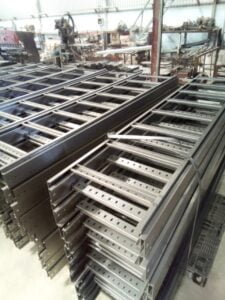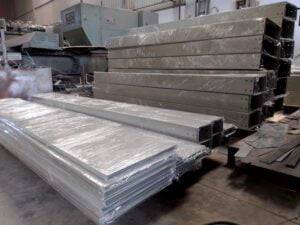

This IEC 61537 vs NEMA VE 1 comparison is important because, in industrial electrical engineering, selecting a cable tray or ladder system involves more than choosing dimensions. Designers must establish the required support span, distributed cable load, fitting configuration and installation environment before selecting a product. The system must also comply with appropriate international standards to provide safe load capacity and corrosion protection. Two of the most widely referenced standards are IEC 61537 (international/European) and NEMA VE 1 (North American).
The following technical comparison explains the principal differences between the two standard systems and shows how their load classifications, test methods, deflection criteria and grounding provisions influence specification decisions. The project specification and current edition of each referenced standard remain authoritative.
1. Overview of the Standards
- IEC 61537: Published by the International Electrotechnical Commission, this standard addresses cable tray and cable ladder system characteristics, load-testing methods and electrical-continuity resistance. Its approach is largely based on performance requirements and test procedures.
- NEMA VE 1: Published by the US National Electrical Manufacturers Association, this standard provides product definitions, test procedures and, notably, a “Class” classification system based on safe working load (SWL). Its approach is strongly oriented toward product classification.
2. Technical Differences in IEC 61537 vs NEMA VE 1
Classification and Safe Working Load (SWL)
This is the most significant difference in the two design approaches and should be reviewed together with the manufacturer’s tested load documentation:
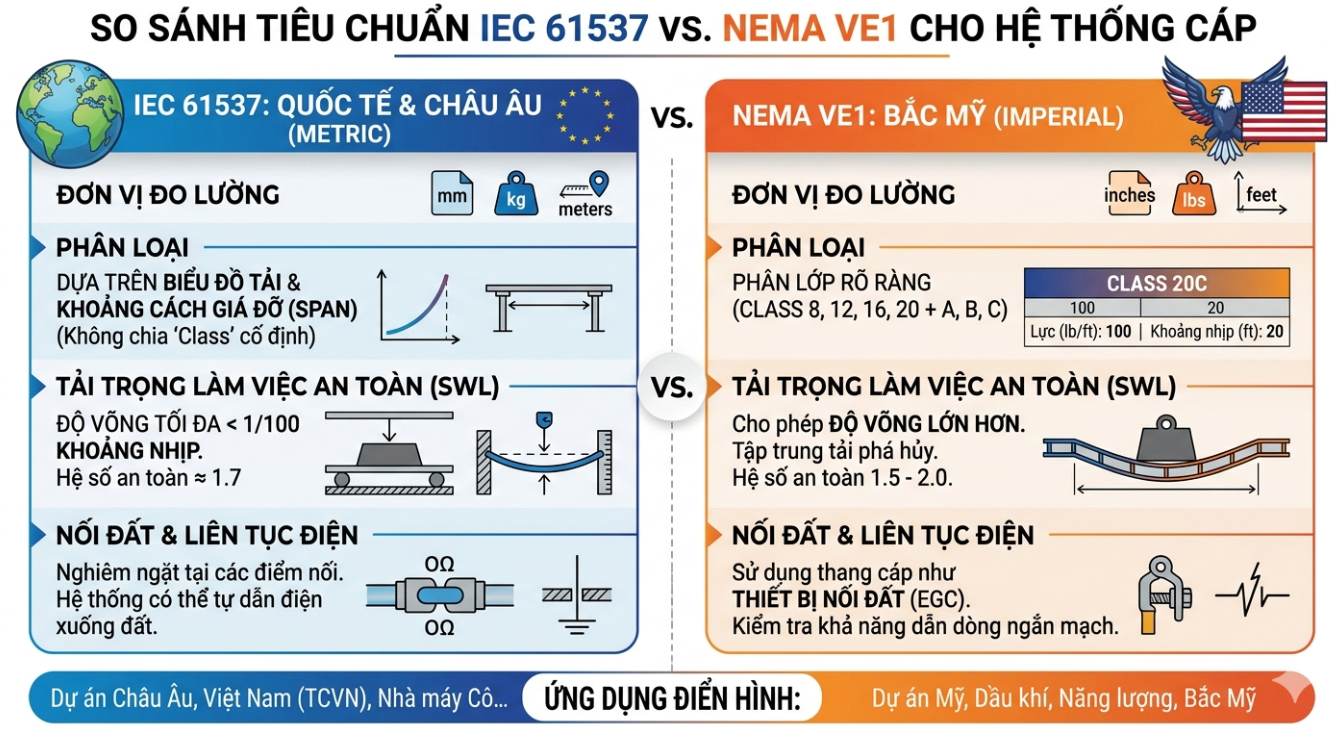
- IEC 61537: It does not prescribe fixed “Classes.” The manufacturer publishes load charts for specified support spans. Load tests are conducted to demonstrate the declared capacity using the applicable safety factor.
- NEMA VE 1: It uses clearly defined groups (8, 12, 16 and 20) corresponding to support spans in feet, together with letter designations (A, B and C) representing load ratings in lb/ft.
- Example: Class 20C indicates a cable ladder rated for 100 lb/ft over a 20 ft support span.
Test Methods and Deflection
- IEC 61537: It sets strict deflection requirements. Maximum deflection must not exceed 1/100 of the span. The safety factor is typically 1.7.
- NEMA VE 1: It permits greater deflection, potentially up to 1/15 or 1/20 of the span depending on the case, while emphasizing ultimate load capacity. The NEMA safety factor commonly ranges from 1.5 to 2.0.
Electrical Continuity and Grounding
- IEC 61537: It establishes strict requirements for continuity resistance across coupler joints. The objective is to ensure that the complete cable tray and ladder system can safely conduct electrical current to earth.
- NEMA VE 1: It addresses the use of cable ladder systems as an Equipment Grounding Conductor (EGC). Splice plates must be evaluated for short-circuit current conduction in accordance with NEC requirements.
3. Summary Comparison
| Characteristic | IEC 61537 | NEMA VE 1 |
| Typical application | Global, Europe and Vietnam | North America, Middle East, oil and gas |
| Measurement units | Metric (mm, kg, m) | Imperial (in, lb, ft) |
| Load classification | Manufacturer’s declared load chart | Class system, for example 12C or 20B |
| Safety factor | 1.7 | 1.5–2.0 |
| Permitted deflection | Very low (1/100 of span) | Higher, with emphasis on strength |
| Surface treatment | According to ISO 1461 | According to ASTM standards |
4. Which Standard Should You Select?
The applicable standard normally depends on the project’s geographical market, contractual requirements and the design consultant’s specification. Product dimensions alone do not demonstrate compliance; manufacturers should provide declared load data and relevant test documentation:
- Select IEC 61537: when the project applies European electrical requirements or TCVN standards. It is appropriate for industrial facilities requiring a visually consistent installation with limited cable-ladder deflection.
- Select NEMA VE 1: for US-designed projects, oil and gas facilities, energy projects or work in markets influenced by ANSI/NEMA standards. These systems commonly provide heavy-duty capacity over long spans.
For the official standard texts, see IEC 61537 on the IEC standards site and NEMA VE 1 on the NEMA standards site.