A solid cable tray and a wire mesh cable tray are both used to hold and protect electrical wires, network cables, air hoses, water pipes, and similar lines in electrical systems, networking systems, cooling systems, and more. However, there are several key differences between a solid cable tray and a wire mesh cable tray.
1. Design
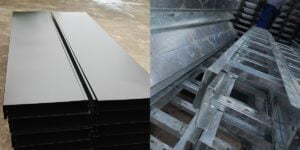
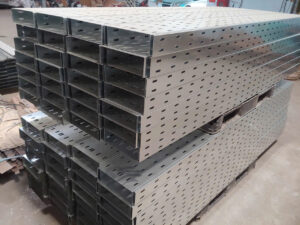
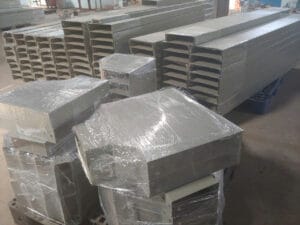
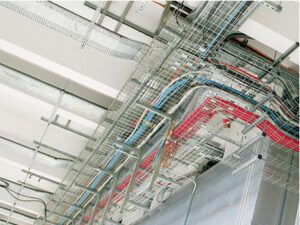
Solid-bottom cable trays typically have a rigid structure with a flat, closed top surface and more angular bends. Wire mesh cable trays, on the other hand, have a more flexible design, formed from thin steel wires woven into square or rectangular openings.
2. Durability
Solid-bottom cable trays generally offer higher load-bearing capacity, supporting weight across a continuous surface. Wire mesh trays resist warping under moderate loads well, but cannot handle as high a load as solid trays. See our related article on the advantages of wire mesh cable trays for more detail.
3. Cost
Solid-bottom cable trays are generally more expensive than wire mesh trays, especially at larger sizes. Wire mesh trays are more affordable, particularly where good ventilation is required.
4. Applications
Solid-bottom cable trays are typically used in electrical systems, networking systems, industrial machinery, and construction projects with demanding requirements. Wire mesh trays are more commonly used in cooling systems, network cabling systems, and similar applications.
In short, the main differences between solid cable trays and wire mesh trays come down to performance characteristics and cost. Both types, however, reliably protect the electrical and network equipment routed inside them.
Comparison Table
| Feature | Solid Cable Tray | Wire Mesh Cable Tray |
|---|---|---|
| Construction | Rectangular, enclosed body with holes for accessories | Mesh formed from interwoven steel or stainless steel wires |
| Material | Steel, powder-coated black sheet steel, galvanized sheet steel, stainless steel | Steel, stainless steel |
| Rigidity | High, strong load-bearing capacity | Lower than solid trays, more flexible |
| Appearance | Depends on material and color; commonly used where a concealed look is desired | More open appearance; commonly used where ventilation is needed |
| Heat dissipation | Lower than wire mesh trays | Higher than solid trays, helping cables dissipate heat better |
| Protection | Strong protection from external impact, dust, and moisture | Moderate level of protection |
| Ease of installation | Easy to install, with many compatible accessories | Easy to install, bends flexibly |
| Typical applications | Construction projects, factories, shopping centers | Industrial electrical systems where good ventilation is needed |
| Price | Varies by material and size, typically higher than wire mesh | Typically cheaper than solid cable trays |
When Should You Choose a Solid Cable Tray?
- Concealment matters: Solid trays shield the cables better and give a cleaner, more finished appearance.
- High durability is required: Solid trays have stronger load-bearing capacity, suited to locations with significant vibration.
- Maximum cable protection is needed: Solid trays better protect cables from environmental factors such as dust and moisture.
See our cable tray product page for more details.
When Should You Choose a Wire Mesh Cable Tray?
- Ventilation is a priority: Wire mesh trays dissipate heat better, reducing the risk of overheating for the cables inside.
- Flexibility is needed: Wire mesh trays bend easily, suited to locations with many angles and turns.
- Budget is limited: Wire mesh trays are generally cheaper than solid cable trays.
See our wire mesh cable tray product page for more details.
Notes When Choosing
- Installation environment: In humid or chemically aggressive environments, choose a cable tray made from a corrosion-resistant material.
- Type of cable: Power cables, network cables, fiber-optic cables, and so on each have different size and tray-type requirements.
- Load: Calculate the load of your cable system to select a tray with adequate load-bearing capacity.
We hope this comparison helps you choose the option best suited to your project. If you have any further questions, feel free to reach out.
For general background on cable routing systems, see the Wikipedia entry on cable trays.