
An industrial electrical system is a complex network designed to distribute, control and protect the electrical power supplied to machinery, production equipment and factory lighting. Safe and efficient operation requires several core components to work together as a coordinated system.
1. Power Supply and Primary Protection Equipment
This is where electrical power enters the installation and receives its highest-level control and protection. It is the starting point of the industrial electrical system.
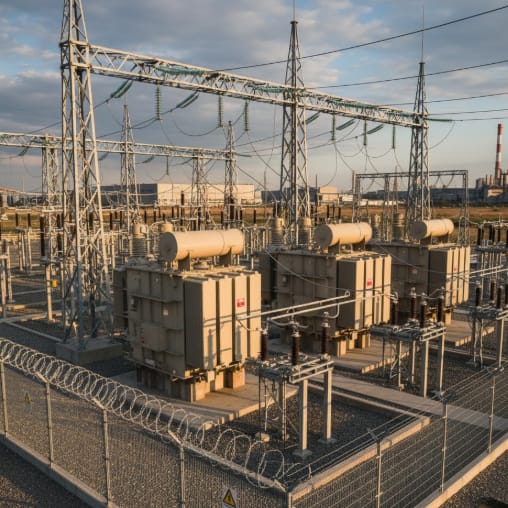
- Transformer
- Function: Reduces the incoming transmission or distribution voltage, commonly medium voltage such as 22kV or 35kV, to industrial utilization levels, typically 380V/220V low voltage.
- Importance: Provides a voltage level compatible with factory equipment requirements.
- Main circuit breaker (CB)
- Function: Acts as the central protective device for the complete low-voltage system. It automatically interrupts the circuit during overload, short-circuit or earth-fault conditions.
- Location: Installed immediately downstream of the transformer or at the incoming section of the Main Switchboard (MSB).
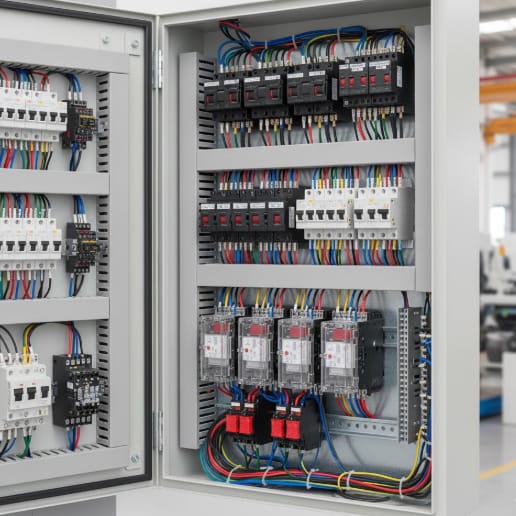
See https://www.se.com/vn/en/product-category/4200-power-circuit-breakers-switches/
- Surge Protective Devices (SPDs)
- Function: Protect electrical equipment from sudden high-voltage impulses caused by lightning or the switching of large loads.
- Importance: Extend equipment service life and reduce damage to sensitive electronic devices.
2. Distribution, Installation and Control Systems
These components distribute power safely and controllably from the main source to individual loads while keeping the conductor system organized.
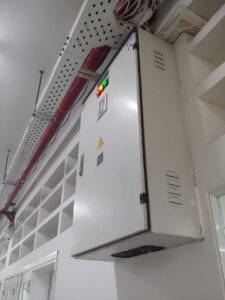
- Switchgear and panelboards
- Function: House and protect switching, control and metering devices. They form the operational backbone of an industrial electrical system.
- Common types: Main Switchboard (MSB), Distribution Board (DB), Motor Control Centre (MCC) and Automatic Transfer Switch (ATS) panel.
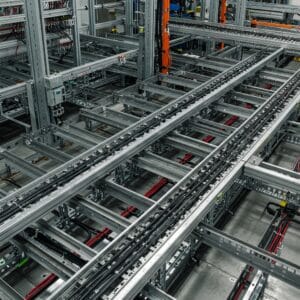
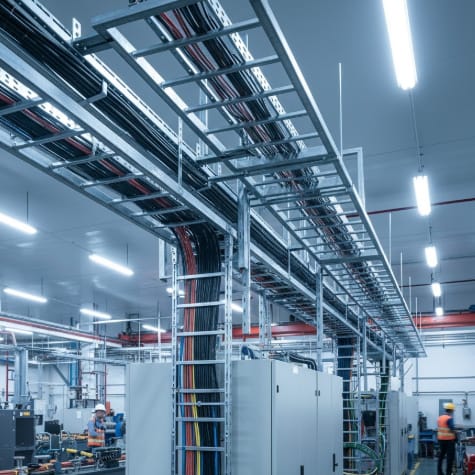
- Cable trays and ladders
- Function: Support and manage power and signal cables. They organize, protect and route cables throughout the factory and are indispensable mechanical components of an industrial electrical system.
- Importance:
- Safety: Help prevent mechanical cable damage and reduce the risk of short circuits or fire caused by abrasion and overheating.
- Appearance and maintenance: Keep cable routes orderly, easy to trace, inspect and maintain.
- Types: Cable ladders for heavier loads and cable trays or trunking for lighter loads.
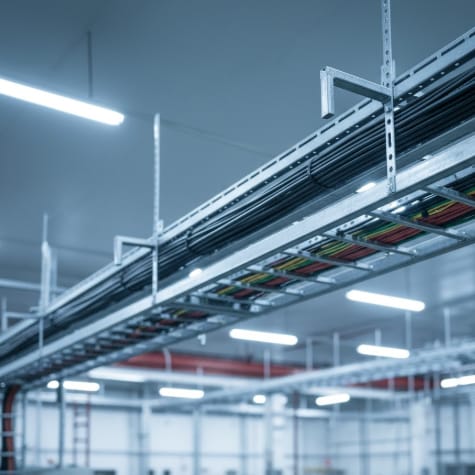
See The Sun cable trays, wire-mesh trays and electrical enclosures
- Cables and conductors
- Function: Carry electrical energy between equipment and therefore act as the system’s arteries.
- Requirements: They must have the correct cross-sectional area for the design load and insulation suitable for the installation environment.
- Secondary switching and branch-protection devices
- Include branch circuit breakers such as MCCBs and MCBs, fuses and relays.
- Function: Protect individual branch circuits or equipment and isolate a fault so it does not interrupt the complete system.
3. Metering and Monitoring Equipment
Metering and monitoring allow operators to follow the operating condition of the industrial electrical system and detect and correct faults promptly.
- Meters
- Measure parameters including voltage (V), current (A), power (W, VA, VAR) and frequency (Hz).
- Common equipment: Multi-function meters measure several parameters simultaneously and can integrate communications.
- Current and voltage transformers (CT/VT)
- Function: Reduce current (CT – Current Transformer) and voltage (VT – Voltage Transformer) from high operating levels to standard instrument levels, commonly $5 ext{ A}$ and $100 ext{ V}$, for meters and protective relays.
- Indicators and pushbuttons
- Indicators: Display equipment states such as ON, OFF and Trip.
- Pushbuttons: Provide manual control of switching devices or machine start/stop functions.
4. Automatic Control Equipment and Loads
This section connects electrical power with the facility’s production processes.
- Motor control devices
- Contactor: A load-switching device that supplies power to a motor in response to a control signal.
- Thermal overload relay: Protects a motor from sustained overload.
- Soft starter or Variable Frequency Drive (VFD): Controls motor speed and torque to save energy and protect mechanical equipment.
- Programmable Logic Controller (PLC)
- Function: Acts as the “brain” of the automation system. It receives sensor inputs and issues commands to actuators such as contactors, valves and pumps according to the programmed control logic.
- Grounding system
- Function: Protects people and equipment by providing a low-impedance path that carries fault current, including lightning and enclosure faults, safely to earth. It is an essential protective component.