The cable tray and ladder market plays an important role in managing and protecting power and signal cables in construction and industrial projects. Its wide range of designs and materials meets the needs of different applications. This article analyses the cable tray market share by design of today’s common designs using statistical data:
- Cable trunking: 35%
- Perforated cable tray: 29%
- Cable ladder: 21%
- Wire mesh cable tray: 13%
- Other: 2%

1. Cable Trunking (36%): Flexibility and Practical Cost
With the leading 36% share, cable trunking (also called cable duct) is widely used for its flexibility and reasonable cost. Its open or enclosed box design, with an optional cover, protects cables from mechanical impact, dust and moisture. Cable trunking is commonly used for low-voltage electrical systems, networks and residential or commercial applications. Its advantages include:
- Easy installation and maintenance: The simple design enables fast installation and convenient cable inspection, additions or replacement.
- Effective protection: An enclosed structure or cover shields cables from external factors.
- Competitive cost: Cable trunking is often less expensive than alternative solutions, making it suitable for budget-conscious projects.
Cable trunking can, however, provide less ventilation, especially for high-heat cable systems.
2. Perforated Cable Tray (29%): Ventilated and Versatile
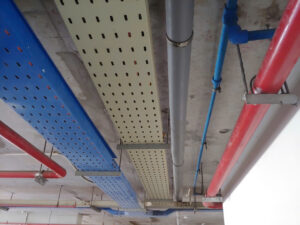
With a 29% share, perforated cable tray ranks second and is preferred for large cable systems that need better ventilation. Its open tray with holes or slots dissipates heat efficiently and extends cable life. Perforated trays are widely used in industrial plants, data centres and projects with high cable density. Key advantages include:
- Excellent ventilation: Reduces the risk of cable overheating.
- Easy cable management: The open design makes routing, inspection and maintenance convenient.
- High load capacity: Suitable for heavy cable systems.
The disadvantage is that a perforated tray provides less protection from dust and direct mechanical impact than enclosed trunking.
3. Cable Ladder (22%): For Long Runs and Heavy Loads
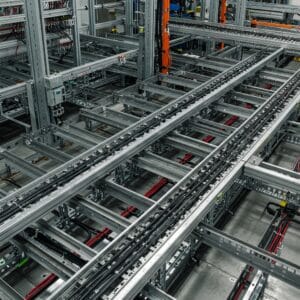
With a 22% share, cable ladder is ideal for large systems with long cable runs and demanding load requirements. Its rung construction provides excellent stability and support. Cable ladders are commonly used in power stations, chemical plants, bridges, transport infrastructure and other heavy industries. Key advantages include:
- Very high load capacity: Supports heavy and complex cable systems.
- Durability and long service life: Robust construction supports long-term operation in harsh environments.
- Easy access and maintenance: The gaps between rungs make inspection and maintenance straightforward.
Its protection from environmental factors is, however, more limited than the two tray types above.
4. Wire Mesh Cable Tray (13%): Lightweight Flexibility for Data and Low-Voltage Systems
With a 13% share, wire mesh cable tray is a modern, flexible solution for data networks, low-voltage systems and applications where appearance matters. Its woven steel mesh maximises ventilation and reduces overall system weight. Advantages include:
- Maximum ventilation: Effectively prevents overheating.
- Low weight: Reduces loads on ceilings and floors.
- Flexible installation and adjustment: Easy to cut, bend and shape for project requirements.
- Attractive appearance: Well suited to modern spaces.
Wire mesh cable trays generally have lower load capacity than perforated trays or cable ladders, and provide less protection from direct mechanical impact.
Conclusion
Market-share statistics show a clear split in cable support design choices, reflecting diverse requirements and applications. Cable trunking remains the leading option because of its flexibility and reasonable cost, while perforated trays and cable ladders meet ventilation and heavy-load requirements for larger systems. Wire mesh cable trays are increasingly popular for their low weight, flexibility and appearance.
Understanding the characteristics, strengths and limitations of each cable support design, together with market-share analysis, helps contractors, engineers and owners make the right choice for each project while optimising safety, performance and cost. The cable tray market is expected to keep developing as new materials and technologies meet the increasingly demanding requirements of construction and industry.