What Should You Consider When Buying Cable Trunking?
When buying cable trunking, there are several important factors to keep in mind to ensure effective installation and use. Here are some things you should consider:
Cable trunking quality
Choose to buy cable trunking of good quality to ensure durability and stability throughout its service life. Cable trunking should be made from fire-resistant and corrosion-resistant material.

Cable trunking size
Make sure the cable trunking size is suitable for easy routing and maintenance. Determine the number and size of the cables you plan to use before purchasing.
Number of cables
Determine the number and type of cables you need to meet your connectivity requirements. Pay attention to size and weight requirements to choose the right type.
Cable protection
Consider buying cable trunking with a cover to protect the cables from animals or environmental impacts.
Performance and standards
Check the performance and safety standards that apply to the cable trunking before purchasing. Make sure the cable trunking meets your requirements.
What standards apply in the cable tray and cable ladder industry? Which standard is right for you? What are the standards commonly seen in Vietnam? Let’s find out about these standards in The Sun’s article on cable trays and cable ladders.
Price and brand
Compare prices and check the reputation of the cable trunking supplier before buying. Choose a reliable supplier with a proven brand.
Keeping these points in mind will help you make a smart decision and buy cable trunking that suits your needs.
How Do You Choose the Right Material?
Why does material matter when choosing cable trunking? Good material ensures the cable trunking has high, long-lasting durability. However, good material also means a higher price. You therefore need to balance durability against cost-effectiveness. Choose the material based on the installation environment.
- Environments with chemicals or sea salt: Use 304 stainless steel cable trunking or aluminum alloy. Hot-dip galvanized steel can also be used, but its durability is not as good as the two options above.
- Humid environments: Use aluminum alloy, 304 stainless steel or hot-dip galvanized steel.
- Typical environments: Powder-coated cable trunking or pre-galvanized steel cable trunking. “Typical” means no chemical fumes, sea salt or excessive humidity. This type can withstand sun, wind and rain as long as water doesn’t pool on it.
Choosing the Size When Buying Cable Trunking
Choose a size that provides enough capacity for your cables without being so oversized that it becomes wasteful. This depends on the number of cables to be installed. See details on how to choose cable trunking based on your cables here: https://thesun.vn/huong-dan-chon-mang-cap/
How Do You Choose the Right Thickness?
Material thickness also directly affects price. The thickness of cable trunking ensures it can withstand impact and the load of the cables. Trunking installed under a raised floor needs to be thicker than suspended trunking. Buyers should therefore keep this in mind as well.
There are two common standards people use to choose thickness. These standards don’t specify thickness directly but set load-bearing requirements. Load-bearing capacity in turn depends on the product’s structure and material thickness. Since the structure of each manufacturer’s cable trunking is largely fixed, the thickness must be calculated accordingly to ensure adequate load capacity. Choosing too thick a material leads to unnecessary added cost.
Choosing by Standard
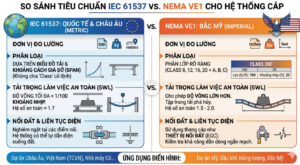
Under the NEMA standard, there are load classes as shown in the table below:

The table above shows the standard has 12 classes. The first number is the span between two supports, measured in feet: 8, 12, 16 and 20 feet, equivalent to 2.4, 3.6, 4.8 and 6.0 meters. A, B and C are load classes. A: 50 lbs/linear foot; B: 70 lbs/linear foot; C: 100 lbs/linear foot — equivalent to A: 75 kg/m; B: 112 kg/m; C: 149 kg/m.
To meet these classes, the requirement is that the product must not fail under load — regardless of how much it deflects (the IEC 61537 standard, by contrast, sets a deflection requirement). As long as the product’s structure remains intact, it passes. For example: cable trunking rated class 8C passes if it does not fail when a load of 149 kg/m is applied over a support span of 2.4m. For a 2.5m section of trunking tested this way, the load applied would be 149 × 2.5 = 372.5 kg, distributed evenly along the trunking.
In practice, the IEC 61537 standard is somewhat easier to apply during installation. Depending on the span between two supports, you can calculate the thickness needed. This standard requires that, under load, deflection must be no greater than 1/300 of the span between supports. For example, if the span between two supports is 1500mm (a common value), then after loading, the deflection at the midpoint between the supports must not exceed 3mm.
What Size Should You Choose When Buying Cable Trunking?
Based on the analysis above, when buying cable trunking you should choose a size that provides enough space for your cables, while also allowing for future expansion. Our article on choosing cable trunking covers this in more detail. For thickness, you can refer to the table below:
| Cable trunking sized 100mm and below | Choose 0.8mm or 1.0mm thickness |
| Cable trunking sized 100mm to 200mm | Choose 1.0mm, 1.2mm or 1.5mm thickness |
| Cable trunking sized 200mm and above | Choose 1.2mm thickness or above |